Orrery Studio Part 5: Multi-Agent Workflow Patterns on a Canvas
Multi-agent workflow patterns are the shapes you wire agents into: a pipeline, a router, a critic loop, parallel branches, a supervisor. These agent orchestration patterns ship with Orrery as eight...
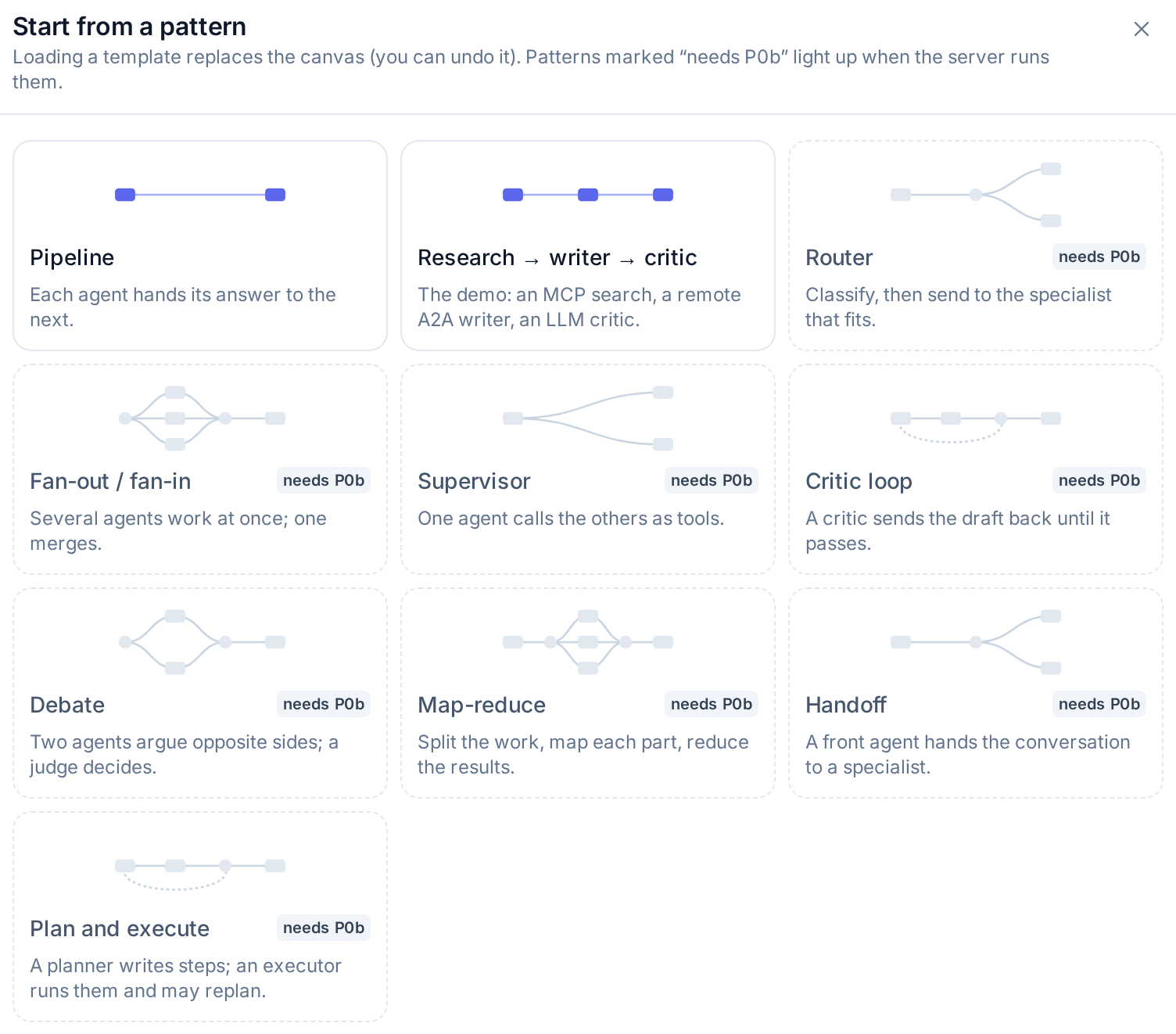
Status, October 2026: Orrery 0.10.0's server runs all eight patterns below. Its console still treats only the pipeline as ready and marks the others "needs P0b"; a tested spec imported from
deploy/studio-demo/specs/runs with Run anyway. In the lab, every node uses one model and runs aren't stored.
Multi-agent workflow patterns are the shapes you wire agents into: a pipeline, a router, a critic loop, parallel branches, a supervisor. These agent orchestration patterns ship with Orrery as eight tested specs, ready to import. This part shows each one, how it compiles to a Google ADK workflow, and the limits that stop a loop of agents from running away with your budget.
Eight Patterns, One Canvas
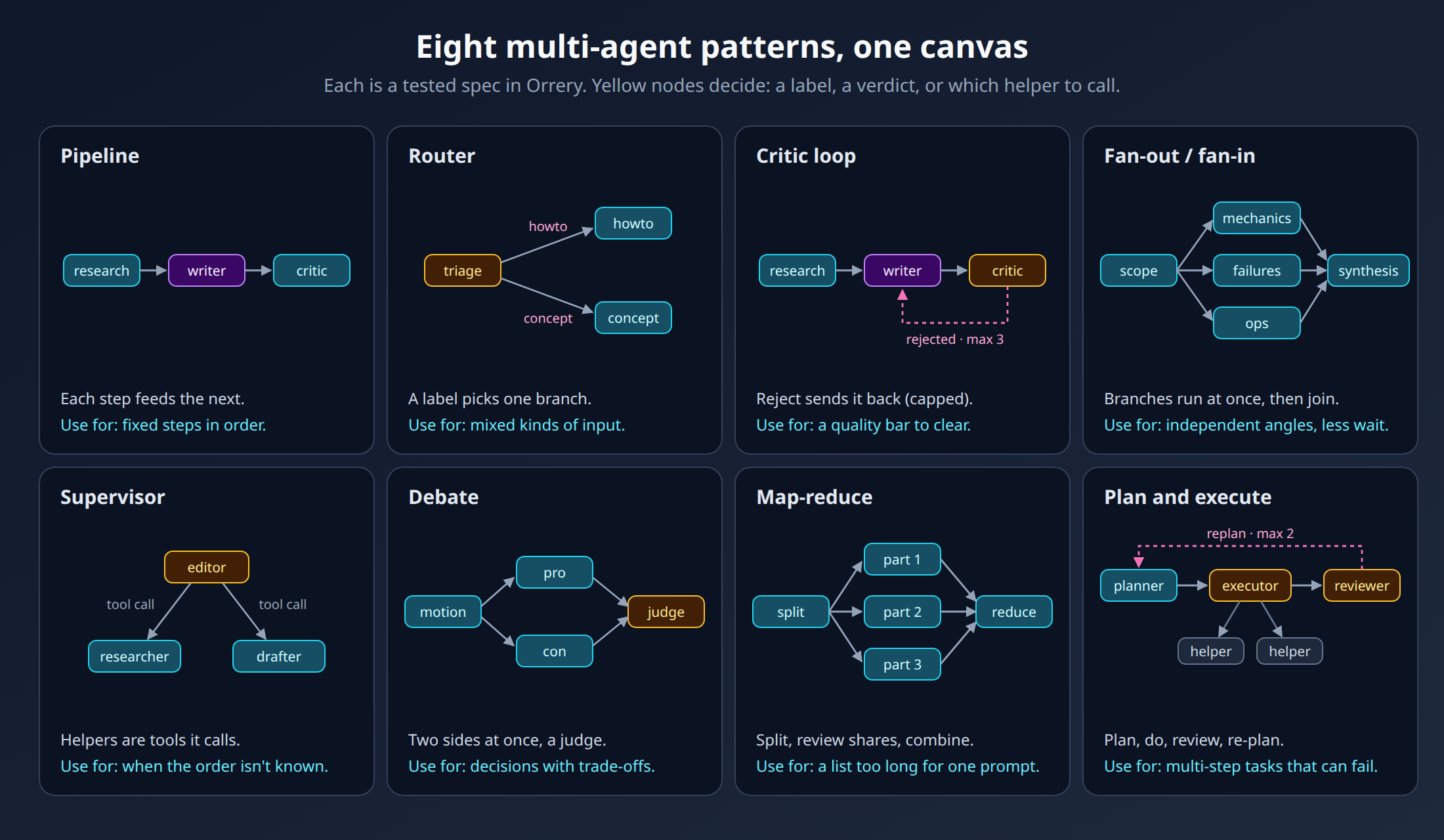
They're built from four kinds of connection:
Sequence: an edge from one node to the next. Pipeline.
Choice: a node answers with a label, and edges marked
whenpick the branch. Router, critic loop.Parallel: a
parallelnode starts 2 to 6 branches at once, and ajoinwaits for all of them. Fan-out/fan-in, debate, map-reduce.Delegation: a
supervisorholds other agents as tools and decides when to call them. Supervisor, plan and execute.
How a Pattern Becomes Code
Every spec compiles to one ADK 2.x Workflow. The interesting parts:
Labels are structured output. A node with
output.labelsmust answer{label, answer}. A small function node reads the label and routes. An answer without a valid label fails the run, rather than taking an arbitrary branch.Loops count themselves. A back edge with
max_iterationsgets a counter. When the cap is hit, the branch ends with the last draft, not the critic's rejection, so the run still succeeds.A join lays answers out. After ADK's
JoinNode, each branch's answer becomes a## branchsection, so the next node reads them in a fixed order.Supervisor helpers are tools. Each child is wrapped as an ADK
AgentTool, traced on its own and counted as a delegation.
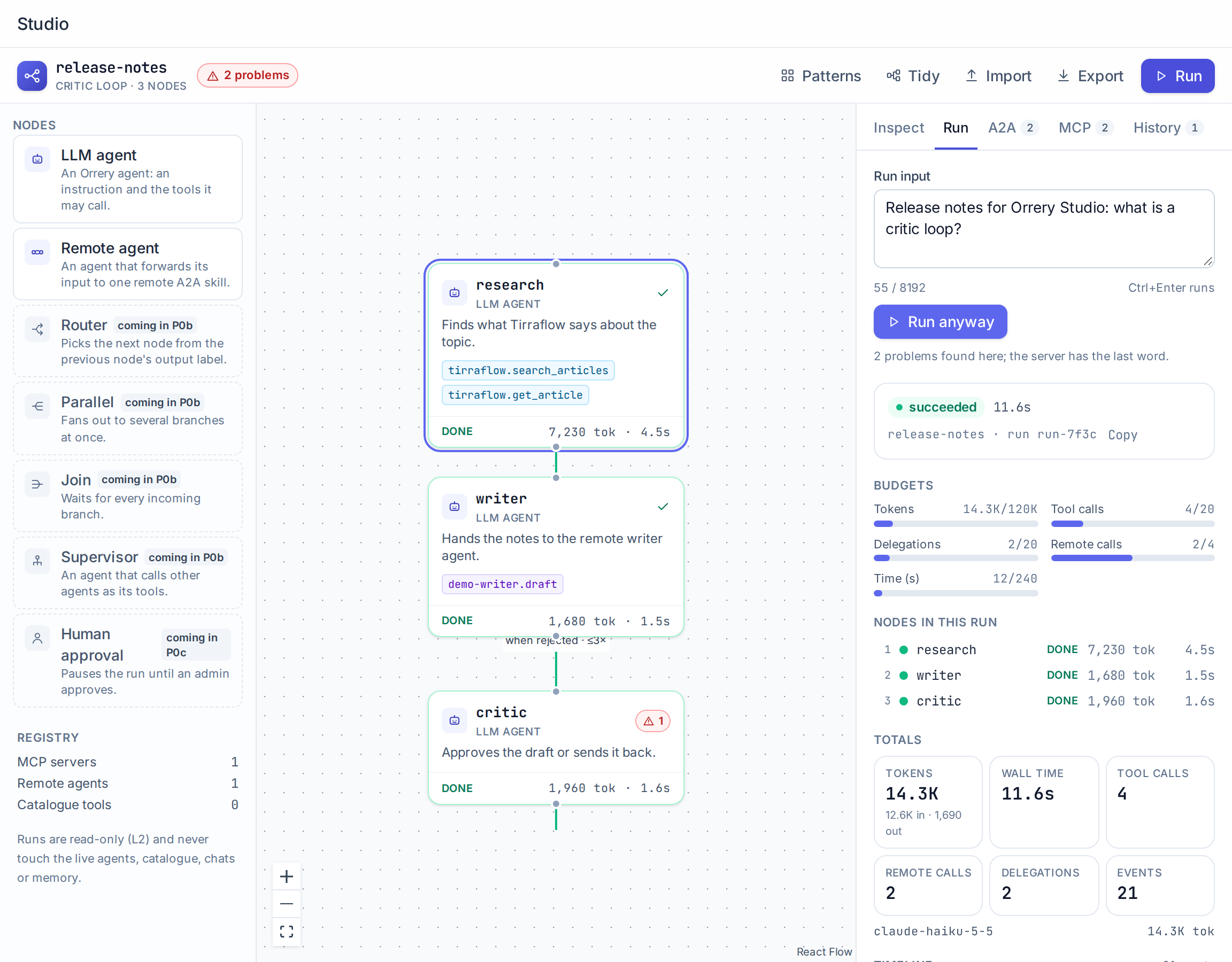
Above, the console after a release-notes critic loop, shown with sample run data: the critic rejects the first draft, the writer goes round once more, and the second draft passes. The red badge is the console gap from the status note; the server accepts the loop.
The Rules That Keep It Bounded
Agents calling agents can loop, fan out and spend tokens faster than anyone notices. So a spec is checked before any model is called:
at most 30 nodes, and 2 to 6 parallel branches;
every cycle needs
max_iterations, at most 5;loops nest at most 2 deep, because inner caps multiply: two levels already allow 36 passes;
supervisors nest at most 3 deep, one parent each;
no loop around a parallel section.
That last rule came from review. ADK's JoinNode doesn't reset between rounds: on the second round it still remembered round one, so it fired early with stale answers. The Studio refuses the shape instead of compiling something subtly wrong. Loop before the parallel, or after the join.
One Budget for the Whole Run
On top of the shape rules, one ledger covers every node. Whichever limit runs out first ends the run with a budget.hit event:
Budget | Default ceiling | Catches |
|---|---|---|
Tokens | 200,000 | cost |
Tool calls | 60 | a node stuck retrying a tool |
Delegations | 20 | a supervisor that never decides (remote A2A calls count here too) |
Remote A2A calls | 20 | ping-pong with a remote agent |
Deadline | 300 s | everything else |
A spec may ask for less, never more. The person's daily token budget still applies on top.
Comparing Patterns and Models
A node may name its own model from the operator's allowlist. It then runs that model alone, without the deployment's fallback chain, so a comparison is honest: if the chosen model fails, you see it fail. The console's history keeps a tab's runs and puts two side by side, for pattern A against pattern B, or model A against model B.
In the lab, per-node models are off: every node runs Claude Haiku 5.5, and the console's history lives in the browser tab.