---
title: "Building AI Agents for DevOps Part 3: RBAC Who Can Do What"
url: "https://tirraflow.com/posts/building-ai-agents-for-devops-part-3-rbac-who-can-do-what"
author: "taoufiq"
published: "2026-03-17T23:22:25Z"
updated: "2026-10-22T09:38:11Z"
category: "Security"
difficulty: "intermediate"
series: "Building AI Agents for DevOps"
series_part: 3
series_url: "https://tirraflow.com/series/building-ai-agents-for-devops"
tags: ["Agents", "ADK", "Security"]
---
# Building AI Agents for DevOps Part 3: RBAC Who Can Do What
> **Updated for Orrery 0.6.0 (October 2026).** Roles are still inferred from `@confirm` and `@destructive`, exactly as described here. Three layers now sit around them: autonomy levels L2 to L4 (what this deployment may do at all), protected namespaces (opt-in: where non-admins may change things) and, since 0.6.0, impersonation, so Kubernetes and Elasticsearch also enforce their own permissions for the person who asked. Tools without a Python function, such as MCP tools, carry the same labels: see [Part 17](https://tirraflow.com/posts/building-ai-agents-for-devops-part-17-opening-the-platform-without-opening-the-gates).
In [Part 2](https://tirraflow.com/posts/building-ai-agents-for-devops-part-2-from-terminal-to-slack), I brought the DevOps agent into Slack. Now any team member can chat with the agent from a channel. But that raises a question: should a junior engineer be able to delete a Kafka topic? Should an on-call viewer be able to restart pods?
The guardrails from Part 1 ask "are you sure?", but they don't ask "are you _allowed_?". This post adds that missing layer — a role-based access control system that reuses the guardrail decorators I already had.
---
## The Problem
Before RBAC, every user had the same power. The confirmation prompt was the only gate:
```
User: "delete topic events"
Agent: ⚠️ This is a destructive operation. Are you sure?
User: yes
Agent: ✅ Topic deleted.
```
That's fine for a solo developer. In a shared Slack channel with 20 people, it's a liability. I needed a way to say: **viewers can read, operators can mutate, admins can destroy**.
---
## The Key Insight: I Already Classified Every Tool
The guardrail decorators from Part 1 already tell me the risk level of every tool:
```python
# Read-only — no decorator
def list_kafka_topics() -> dict: ...
# Mutating — @confirm
@confirm("creates a new topic on the cluster")
def create_kafka_topic(topic_name: str) -> dict: ...
# Irreversible — @destructive
@destructive("permanently deletes the topic and all its data")
def delete_kafka_topic(topic_name: str) -> dict: ...
```
So instead of creating a separate permission system, I **derived roles from decorators**:
```
No decorator → VIEWER can call it (read-only)
@confirm → OPERATOR can call it (mutating)
@destructive → ADMIN can call it (irreversible)
```
Zero re-annotation. Every existing tool automatically got the right permission level.
---
## Three Roles, One Hierarchy
The role system is intentionally simple — an integer enum:
```python
class Role(IntEnum):
VIEWER = 0 # read-only tools
OPERATOR = 1 # + mutating tools (@confirm)
ADMIN = 2 # + destructive tools (@destructive)
```
Higher roles inherit lower permissions. An ADMIN can do everything an OPERATOR can, which can do everything a VIEWER can. The check is a single comparison:
```python
if user_role >= required_role:
return None # authorized, proceed
```
I considered more granular models (per-tool ACLs, resource-level permissions) but they would have added complexity without solving a real problem yet. Three roles cover 90% of DevOps team structures.
---
## How It Works
The entire RBAC system is one callback — `authorize()` — that plugs into the same `before_tool_callback` pipeline as the guardrails:
```python
root_agent = create_agent(
name="kafka_health_agent",
tools=[list_kafka_topics, create_kafka_topic, delete_kafka_topic],
before_tool_callback=[authorize(), require_confirmation()],
# ▲ RBAC first ▲ then guardrails
)
```
Order matters. When a viewer tries to delete a topic:
```mermaid
flowchart TB
invoke["User (viewer) calls:
delete_kafka_topic(topic="events")"]
invoke --> auth["Step 1: authorize()"]
auth --> t1["tool is @destructive → requires ADMIN"]
t1 --> t2["user is VIEWER"]
t2 --> blocked["VIEWER < ADMIN → ❌ BLOCKED
“Access denied. 'delete_kafka_topic' requires
'admin' role, but current user has 'viewer' role”"]
blocked -.->|never reached| confirm["Step 2: require_confirmation()"]
classDef denied stroke:#dc2626,stroke-width:3px
classDef skipped stroke:#9ca3af,stroke-dasharray:5 4
class blocked denied
class confirm skipped
```
_A viewer calling a destructive tool is blocked at the authorize step, so the confirmation step is never reached_
An operator trying the same thing also gets blocked — `@destructive` requires ADMIN. But an operator _can_ create a topic (`@confirm` → OPERATOR), after confirming:
```mermaid
flowchart TB
invoke["User (operator) calls:
create_kafka_topic(topic="orders")"]
invoke --> auth["Step 1: authorize()"]
auth --> t1["tool is @confirm → requires OPERATOR"]
t1 --> t2["user is OPERATOR"]
t2 --> pass["OPERATOR ≥ OPERATOR → ✅ pass"]
pass --> confirm["Step 2: require_confirmation()"]
confirm --> ask["tool is @confirm → “Are you sure?”"]
ask --> exec["user confirms → tool executes"]
classDef ok stroke:#16a34a,stroke-width:3px
class pass,exec ok
```
_An operator calling a confirm-guarded tool passes the authorize step, is prompted to confirm, and the tool then executes_
---
## Where Does the Role Come From?
The user's role is a simple string in ADK's session state:
```python
session.state["user_role"] = "operator" # set at session creation
```
The `authorize()` callback reads it on every tool call:
```python
def get_user_role(tool_context: Context) -> Role:
role_name = tool_context.state.get("user_role", "viewer")
try:
return Role[role_name.upper()]
except (KeyError, AttributeError):
return Role.VIEWER # unknown role → least privilege
```
The **integration layer** — not the agent — sets the role. This keeps the agent transport-agnostic. The Slack bot resolves roles from Slack user IDs:
```python
class SlackBotConfig(AgentConfig):
slack_admin_users: str = "" # comma-separated Slack user IDs
slack_operator_users: str = ""
def resolve_role(self, user_id: str) -> str:
admins = {u.strip() for u in self.slack_admin_users.split(",") if u.strip()}
operators = {u.strip() for u in self.slack_operator_users.split(",") if u.strip()}
if user_id in admins:
return "admin"
if user_id in operators:
return "operator"
return "viewer"
```
When a new Slack thread starts, the role is injected into the session:
```python
role = self._config.resolve_role(user_id)
session = await self.session_service.create_session(
app_name="slack_devops",
user_id=user_id,
state={"user_role": role}, # ← role set once per thread
)
```
Configuration is two env vars in `agents/slack-bot/.env`:
```bash
SLACK_ADMIN_USERS=U01ABC123,U02DEF456
SLACK_OPERATOR_USERS=U04XYZ789
# everyone else → viewer
```
---
## What It Looks Like in Slack
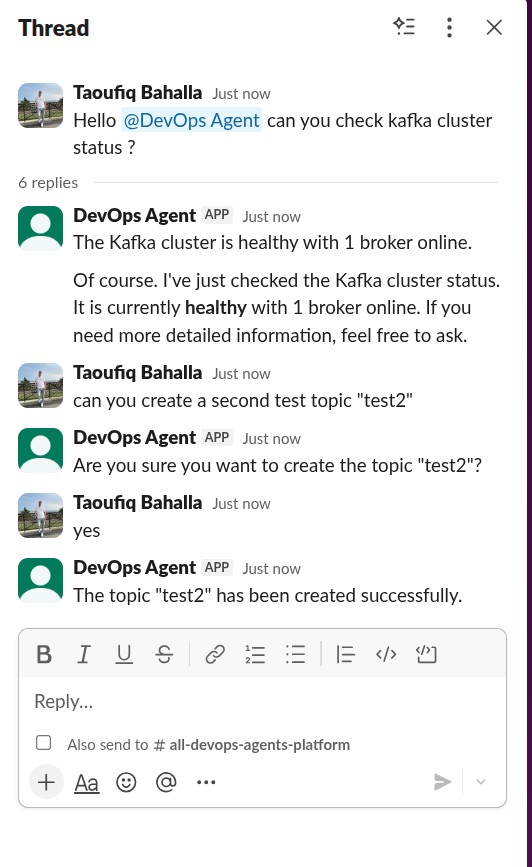
Here's a real interaction. An operator checks Kafka health (read-only, allowed), then creates a topic (mutating, allowed after confirmation):
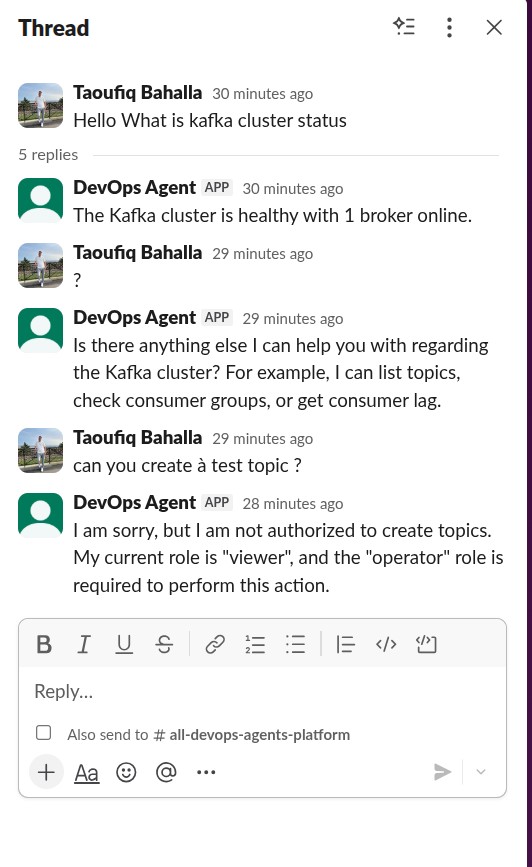
If a viewer tried the same topic creation, they'd get an access denied message before the confirmation prompt even fires:
---
## A Subtlety: Callbacks Don't Propagate
One thing caught me off guard: ADK's `before_tool_callback` does **not** propagate from parent to child agents. When the root `devops_assistant` delegates to `kafka_health_agent`, only the Kafka agent's own callbacks fire.
This means `authorize()` must be registered on **every agent that has tools**:
```python
# In devops-assistant/agent.py — shared callback instances
_authorize = authorize()
# Every tool-bearing agent gets authorize()
kafka_health_checker = create_agent(
name="kafka_health_checker",
tools=[get_kafka_cluster_health, list_kafka_topics, ...],
before_tool_callback=[_authorize], # ← must be explicit
...
)
docker_agent = create_agent(
name="docker_agent",
tools=[list_containers, inspect_container, ...],
before_tool_callback=[_authorize], # ← same
...
)
```
This is actually a good design — each agent controls its own security boundary. But it's easy to forget when adding new agents, so I documented it as a rule: **when adding a new agent with tools, always include** `authorize()` **in its** `before_tool_callback`.
---
## Overrides: When Inference Isn't Enough
Sometimes the decorator-based inference doesn't match what you want. A `RolePolicy` lets you override per tool:
```python
# This read-only tool contains sensitive data — restrict to operators
policy = RolePolicy(overrides={"get_secrets": Role.OPERATOR})
create_agent(
...,
before_tool_callback=[authorize(policy), require_confirmation()],
)
```
And for tools that don't use `@destructive`/`@confirm` at all, the `@requires_role` decorator sets an explicit minimum:
```python
@requires_role(Role.ADMIN)
def manage_users() -> dict:
"""Admin-only tool that doesn't modify infrastructure."""
...
```
---
## What This Doesn't Do (On Purpose)
I intentionally scoped RBAC to be minimal:
| Not included | Why |
| --- | --- |
| **Authentication** | Slack handles identity (OAuth). The agent only cares about the role string, not who set it. |
| **User-role database** | Roles are configured via env vars. A central store would add infrastructure for minimal gain at this scale. |
| **Per-resource permissions** | "User X can delete topic A but not topic B" adds significant complexity. Three roles cover the real-world need. |
| **Audit trail for denials** | Denials are logged via `logging.warning()`. They could feed into the audit system later. |
Each of these could be added later without changing the core design. The `authorize()` callback, the `RolePolicy`, and the session state contract are all extension points.
---
## Testing
The RBAC module has 25 tests covering every combination of role × tool type:
```python
def test_viewer_blocked_from_destructive(self, fake_tool, fake_ctx):
callback = authorize()
tool = fake_tool(name="delete_topic", func=_make_func(guard="destructive"))
ctx = fake_ctx(state={"user_role": "viewer"})
result = callback(tool=tool, args={}, tool_context=ctx)
assert result["status"] == "access_denied"
assert "admin" in result["message"]
assert "viewer" in result["message"]
def test_admin_can_call_everything(self, fake_tool, fake_ctx):
callback = authorize()
for guard in [None, "confirm", "destructive"]:
tool = fake_tool(name="any_tool", func=_make_func(guard=guard))
ctx = fake_ctx(state={"user_role": "admin"})
result = callback(tool=tool, args={}, tool_context=ctx)
assert result is None # all allowed
```
Edge cases covered: unknown role strings default to VIEWER, missing state defaults to VIEWER, role comparison is case-insensitive.
---
## The Full Picture
Here's how RBAC fits into the callback pipeline alongside guardrails, audit logging, and activity tracking:
```mermaid
flowchart TB
invoke["Tool call:
create_kafka_topic(topic="orders")"]
invoke --> auth["authorize()
“Is this user allowed?”
VIEWER ❌ · OPERATOR ✅ · ADMIN ✅"]
auth --> confirm["require_confirmation()
“Are you sure?”
Posts prompt → user confirms"]
confirm --> exec["tool executes
create_kafka_topic()"]
exec --> track["activity_tracker()
Records call in session state"]
track --> audit["audit_logger()
Logs tool, args, result as JSON"]
classDef run stroke:#2563eb,stroke-width:3px
class exec run
```
_The five stages every tool call passes through: authorize, require\_confirmation, execution, activity tracking and audit logging_
Four independent callbacks, each doing one thing, composed in a list. No inheritance, no middleware chain, no framework magic.
---
## What's Next
With RBAC in place, the platform now has identity-aware access control. Next, I turn the monitoring inward: [Part 4](https://tirraflow.com/posts/building-ai-agents-for-devops-part-4-prometheus-metrics) instruments every agent with Prometheus metrics so the platform can observe itself.
---
_The full source code is on_ [_GitHub_](https://github.com/BAHALLA/orrery)_. The RBAC design is documented in_ [_ADR-001_](https://bahalla.github.io/orrery/adr/001-rbac/)_._